Are graduates entering work without the skills employers need? It is an increasingly common question. But new research suggests it may be the wrong question to ask on its own. Employers are certainly concerned about skills. Yet some of the biggest gaps they are seeing in new hires sit elsewhere: adapting to workplace demands, motivation, self-awareness and understanding how to operate effectively in a professional environment. At the same time, artificial intelligence is beginning to reshape the very entry-level roles graduates are preparing for. That creates a more complicated challenge. How do we prepare someone to be ready for work when the work itself is changing?

Graduate work readiness is becoming a bigger employer concern
The Institute of Student Employers’ Student Development Survey 2026, based on responses from 144 employers, found that 35% said graduate hires fell below expectations when adapting to workplace demands.
Employers also reported readiness gaps in motivation and self-awareness, wider contextual understanding, and planning and organising.
More than half, 52%, had increased the amount of induction time devoted to professional conduct and supporting the transition from education into employment. That tells us something important. The challenge employers are experiencing is not simply whether a graduate possesses enough technical knowledge. It is also whether someone can take what they know and begin operating effectively in a workplace.

Employability and work readiness are not quite the same thing
This distinction is becoming increasingly important. A 2026 academic review examining graduate employability and work readiness concluded that although the two concepts are related, they should not simply be treated as interchangeable. The researchers argue that work readiness extends beyond basic or technical skills and requires more targeted development. A graduate can therefore be highly employable on paper:
- a strong degree
- relevant technical knowledge
- work experience
- a polished CV
But that does not automatically tell us how prepared they are to navigate the reality of work. Can they adapt when expectations change? Do they understand how they tend to communicate? Can they recognise where they need development? Do they understand what motivates them? Can they make sense of feedback, uncertainty and competing priorities? These are different questions.

AI makes the work-readiness question more urgent
The same ISE research found that 87% of employers expect graduate and apprentice roles to be reshaped by AI during the next three years.
Most are expecting roles to change rather than simply disappear: tasks are likely to evolve, with employers placing greater value on capabilities such as judgement, critical thinking and the ability to work effectively alongside new technology. This matters because traditional graduate development often starts from a reasonably stable assumption:
Here is the role. Here are the skills required. Here is the development programme that will help you perform it.
That assumption becomes harder to maintain when the role may itself change during somebody’s first few years at work. Work readiness therefore cannot only mean preparing a graduate for the job they are entering today. Increasingly, it must also mean helping them understand how they learn, respond, communicate and develop as that job changes around them.
Graduates themselves are navigating the same uncertainty

There is another side to the issue. Prospects’ Early Careers Survey 2026, which captured the views of 4,990 students and graduates, found that 35% felt AI had reduced their career opportunities. At the same time, 41% were not confident that they were developing the AI-related skills they would need for their future career. And despite all the discussion around technology, employment and skills, the most commonly reported challenge was more human: 50% said staying motivated had been their biggest challenge during the previous year. So employers are questioning readiness while graduates are trying to navigate uncertainty about where work is heading. That makes it difficult to reduce the issue to: “Graduates need more skills.” There is clearly more happening.
Perhaps we are starting graduate development one step too late
Employers invest heavily in graduate development. Universities provide careers guidance, employability support and preparation for recruitment. Graduates themselves work hard to accumulate qualifications, technical skills, internships and experience. All of those things matter. But there may be a missing step before development begins:
Does the individual understand themselves well enough to know what they need to develop?
Consider three graduates joining the same organisation. One may have strong technical ability but lack confidence when communicating an idea. Another may communicate comfortably but struggle when the structure around them becomes unclear. A third may perform perfectly well but have little understanding of what actually motivates them or what kind of career they want to build. A standard development programme can give all three valuable skills. But it does not automatically tell us which development matters most to each person. That distinction becomes even more important when organisations want development programmes to lead to engagement, progression and longer-term career direction rather than simply successful onboarding.
Self-awareness should not be treated as a soft extra
The ISE finding around motivation and self-awareness is therefore particularly interesting. Self-awareness in an early-career context is not simply knowing whether someone is introverted or extroverted. Useful professional self-awareness is much more practical. It is understanding things such as:
- how you tend to respond to different situations;
- what motivates you;
- where your stronger patterns lie;
- where development may be useful;
- how you communicate and work with others;
- what kind of environment may help you contribute effectively;
- and what you are actually trying to build towards.
That does not replace technical skills. It makes development more intentional.
What could this mean for graduate and early-career programmes?
There is a useful question here for employers, universities and organisations supporting early careers:
Should individual insight come before we decide what development somebody needs?
Rather than beginning every graduate journey with a predefined development pathway, there may be value in first understanding the person entering it. That could allow subsequent coaching, mentoring, learning and career conversations to become more focused. It could also help the individual take greater ownership of their development because they understand why a particular area matters to them, rather than simply completing another programme module. This is not an argument for replacing existing graduate programmes. It is an argument for giving those programmes a better starting point.
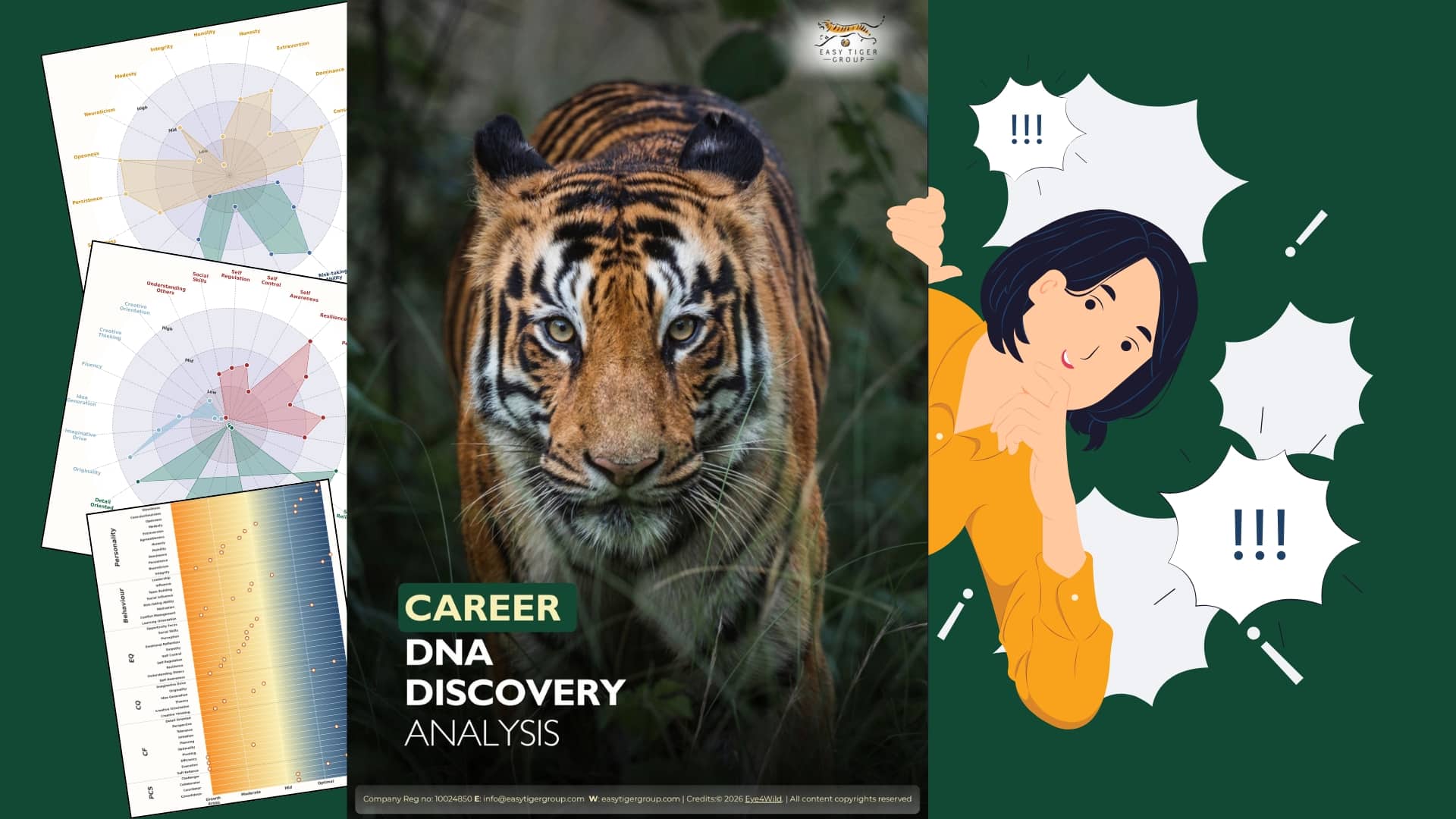
This is one of the reasons Easy Tiger Group developed Career DNA Discovery™ Analysis.
Career DNA Discovery™ is a professional development analysis designed to help individuals understand how they think, respond, communicate and grow within their own career context. It begins with the individual’s current position, aspirations, motivation, values and working preferences. It then uses different response formats, workplace scenarios and interactive tasks to identify patterns that can be connected to strengths, development areas, learning actions and possible career directions. It is not designed to place somebody into a fixed personality category or tell them which job they must pursue. For a graduate or early-career professional, that can provide a clearer starting point for making career and development decisions. But there is also a wider organisational opportunity.
Career DNA Discovery™ could sit alongside an existing graduate programme, university employability service, early-career initiative, coaching programme or professional-development pathway, providing an additional layer of individual insight before development decisions are made. The objective is not to replace what already exists. It is to make what happens next more personal and more focused.
The graduate readiness question needs to change
The evidence emerging in 2026 suggests that graduate work readiness should not be reduced to a checklist of missing skills. Technical capability matters. AI capability matters. Communication, judgement and adaptability matter. But underneath all of those sits something more fundamental:
Does the individual understand enough about themselves to know how they need to grow?
As roles become less predictable, that may become one of the most important capabilities we can help people develop. Because the aim should not simply be to prepare a graduate for their first job. It should be to help them build enough self-understanding to keep developing as their career, their organisation and the work itself continue to change.
A conversation worth starting
If you are responsible for graduate development, early careers, employability or professional development, we would be interested in how you currently build individual self-awareness into the journey. Easy Tiger Group is also exploring conversations with organisations interested in using Career DNA Discovery™ alongside existing graduate, employability and early-career development programmes. For individuals starting their careers, Career DNA Discovery™ provides a structured way to understand your strengths, development areas and possible next steps before deciding where to focus your development.
For more detail on how the framework is structured and the research informing it, explore the Career DNA Discovery™ methodology.
Research referenced
Institute of Student Employers, Student Development Survey 2026
Prospects at Jisc, Early Careers Survey 2026
Caballero et al., Untangling graduate employability and work readiness to inform evidence-based practice in higher education, 2026