AI in the workplace is already changing how work gets done.. For many employees, the benefits are becoming tangible. PwC’s UK Workforce Hopes & Fears Survey 2026, based on 2,023 UK workers, found that 19% now use AI every day at work. Among people using AI:
70% said it had improved the quality of their work.
63% said it allowed them to use more of their skills.
58% said it increased the value they bring to their employer.
Those are meaningful gains. But the same research revealed something less straightforward.
44% said their workload had increased.
45% said their work had become more complex.
So AI can improve the work someone produces without necessarily making their working life easier. That distinction matters. Because as organisations move from experimenting with AI to embedding it into everyday work, the question cannot only be:
How much more productive can we become?
It also needs to be:
What is changing for the person doing the work?
AI productivity and employee workload are not the same thing
Consider a simple example. A task that previously took four hours can now be completed in two. Two hours of capacity have been created. What happens to them? They might create more time for judgement, creativity, customer relationships, problem-solving or development. The organisation might redesign the role around higher-value work. Or those two hours might simply be filled with more tasks. The technology has made the task more efficient.
But has the job improved?
That is where conversations about AI productivity can become too narrow. Efficiency tells us something about the task. It tells us much less about workload, expectations, role complexity or whether the work surrounding that task has changed at all.
The productivity problem may not be a lack of technology
Another finding from PwC deserves attention. When UK workers were asked what was affecting their productivity:
29% identified fatigue and burnout.
28% identified workload pressure.
Only 13% cited a lack of skills or training as one of the biggest barriers.
That does not mean skills and training are unimportant. It does suggest organisations need to diagnose the problem carefully before deciding what the solution should be. If employees are already experiencing significant workload pressure, introducing another tool or expecting greater output may not address the underlying problem. Sometimes the better question is not:
How can this person become more productive?
It is:
Why is the work structured this way in the first place?
That moves the conversation from technology adoption into job design and workforce planning.
Automating a task is not the same as redesigning a job
Jobs are made up of more than isolated tasks. They also contain judgement, responsibility, relationships, learning, decision-making and experience. Imagine a junior employee who previously spent several hours preparing a report. AI can now produce much of the first draft. The organisation still has a decision to make. Does that employee use the time to interpret the information more deeply? Spend more time with customers? Develop another capability? Take on responsibilities that previously sat elsewhere? Or simply produce twice as many reports?
Those are not AI decisions. They are business and work design decisions.
There may also be consequences that are less visible. Some routine activities are where people learn how an organisation operates. Remove those tasks and something may need to replace the learning that happened through them. An efficiency gain in one part of the job can therefore create a development gap somewhere else. The task may have changed quickly. The role around it needs more thought.

AI is not being experienced equally across the workforce
AI adoption is also uneven. PwC found that 85% of UK senior executives and 73% of managers had used AI at work, compared with 35% of non-managers. That difference matters. The people shaping an organisation’s AI strategy may be experiencing the technology very differently from many of the employees whose roles will ultimately be affected by it. One team may already be using AI to remove repetitive work. Another may be taking on additional responsibilities because automation has changed how work flows through the organisation. Others may still be unclear about what AI means for their role at all. So describing an entire organisation as “AI ready” can hide important differences. Different teams may have different levels of capability. Different roles may change at different speeds. Some people may need technical development. Others may need clearer expectations, new responsibilities or more support through change. Technology can be deployed consistently. People do not experience change consistently.
We explored the same challenge from an early-career perspective in our recent analysis of graduate work readiness and AI-driven role change.
The hidden workforce decision: what happens to the capacity AI creates?
This may be one of the most important questions organisations now need to answer. When AI releases time or capacity, what should happen to it? There is no single correct answer. In some roles, increasing output may be exactly what the business needs. Elsewhere, the better use of that capacity may be improving quality, solving more complex problems, developing people or strengthening customer relationships. The risk is allowing the answer to happen by default. If every efficiency automatically becomes a higher workload expectation, AI may increase output without fundamentally improving the design of work. Organisations could end up automating tasks while leaving jobs largely unchanged. That is why AI transformation increasingly needs to become a workforce conversation, not just a technology conversation.

Understand the workforce before you redesign the work
Before organisations redesign roles around AI, they need a clearer picture of the workforce they already have. Where does capability currently sit? Where are teams stretched? Which skills may become more important? Where could existing talent be developed or redeployed? Which responsibilities are changing? Where might workload pressure increase? And which people or teams may need greater clarity or support as the organisation evolves? Those questions matter because the answer to transformation is not always external recruitment. Existing employees may already have transferable capability that becomes more valuable as roles change. Others may be able to move into redesigned roles with targeted development. Some teams may already be operating under enough pressure that adding further expectations creates risk rather than productivity. Better workforce decisions start with better visibility.
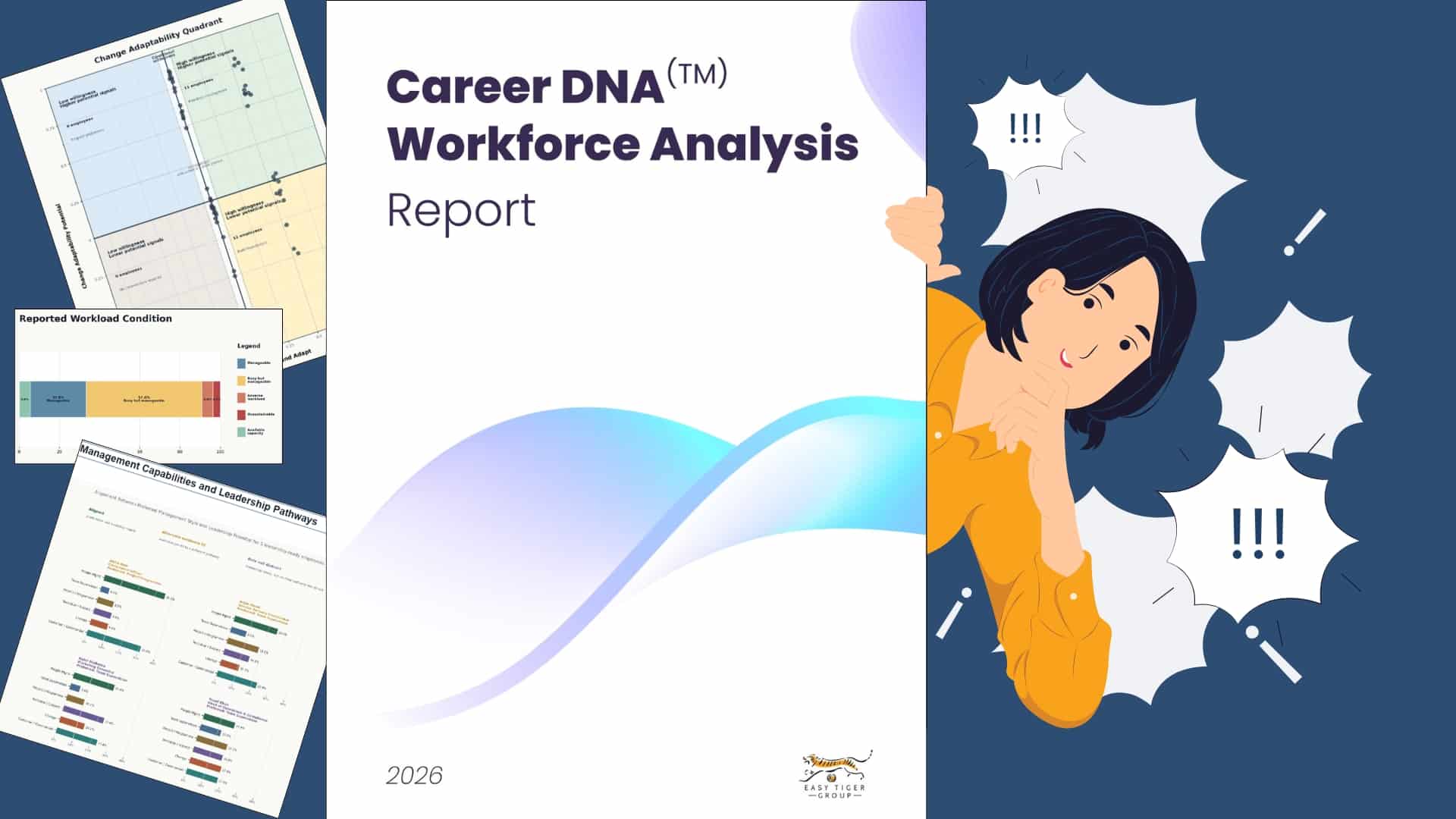
Workforce Analysis™ by Easy Tiger Group helps organisations build that clearer view. It is designed to provide insight into areas including:
- workforce capability
- skills gaps
- workload pressure
- development needs
- internal mobility
- and readiness for change
It can support organisations considering AI readiness, role redesign, restructuring, workforce planning, succession and wider organisational change. Workforce Analysis™ is not designed to make those decisions automatically. Nor should its findings be considered in isolation. The most useful decisions also take account of performance, role requirements, technical capability, organisational priorities, employee aspirations and future workforce demand. Its purpose is to improve the starting point. To help leaders understand the people behind the roles before deciding how those roles should change.
The question is not simply: “Who is ready for AI?”
That question may be too narrow. A more useful set of questions might be:
How is the work changing? What capability do we already have? Where is pressure increasing? What could be developed internally? Which roles need to evolve? Where will people need greater clarity or support?
And ultimately:
What should this workforce look like once the transformation is complete? Those questions connect AI adoption with workforce planning rather than treating them as separate exercises.
Successful AI transformation may need different measures
Organisations will continue to measure AI adoption. Who is using it? How often? Which tools? How much time is being saved? Those are useful measures. But they are not enough to tell leaders whether AI is improving work. A more complete view would also ask: Has unnecessary work actually reduced? Has workload changed? Are roles clearer? Are people using the capacity created by AI for higher-value work? Are employees developing the capabilities the organisation will need next? Are managers equipped to lead teams whose work is changing? Can existing talent move into new or redesigned roles?
Those questions move the conversation from using AI to designing work around AI. And that distinction is becoming increasingly important. Because better technology does not automatically create better jobs.
AI made the task faster. Did it make the job better?
That may become one of the more useful questions for organisations navigating AI-led transformation. Not because every efficiency should reduce workload. And not because every role should remain as it is. But because productivity gains tell only part of the story. The wider opportunity is to understand what AI is changing across the task, the role, the person and the workforce around them. That is where technology transformation becomes workforce transformation.
A conversation worth starting
If your organisation is introducing AI, redesigning roles or reconsidering future workforce requirements, it may be worth examining the people side of that transformation before making decisions about structure, recruitment or development. Workforce Analysis™ by Easy Tiger Group helps organisations understand existing capability, workload pressure, development priorities and readiness for change so workforce decisions can begin with a clearer view of the people already inside the business.
Research referenced
PwC UK, Workforce Hopes & Fears Survey 2026
Research covering AI adoption, work quality, workload, complexity and productivity pressures among UK workers.
PwC UK, AI transformation and the workforce
Analysis examining how organisations can move beyond AI adoption towards redesigning work and supporting people through change.
PwC UK, Work and operating-model redesign
Analysis of how technology, job design, skills and organisational structures need to evolve together.