
Career DNA Discovery™ Methodology
A research-informed approach to professional development.
Career development is rarely explained by one trait, one score or one moment in time. Career DNA Discovery™ Analysis was developed around a broader question:
How can established research, professional context and different forms of evidence be brought together to help someone understand how they think, respond, communicate and grow?
Career DNA does not attempt to replace established psychological models, nor does it reproduce an existing personality or career assessment. Instead, recognised research provides the foundations. Easy Tiger Group has applied those foundations through a professional-development lens, defining a framework of 49 documented metrics across six categories, then developing questions, scenarios and interactive tasks designed to explore relevant patterns. The methodology has continued to evolve through research review, structured pilot testing and practitioner feedback.

Established research provides the foundation
Career DNA Discovery™ Analysis was not developed by creating new theories about personality, behaviour or human capability.
Its methodology draws from established areas of psychological, behavioural and workplace research, then applies those areas to a defined professional-development purpose.
This distinction matters.
The studies and frameworks referenced throughout the methodology inform the conceptual foundations of Career DNA. Career DNA does not claim to reproduce those instruments or to be equivalent to them.
Six areas
of
professional
development
Career DNA Discovery™ Analysis explores
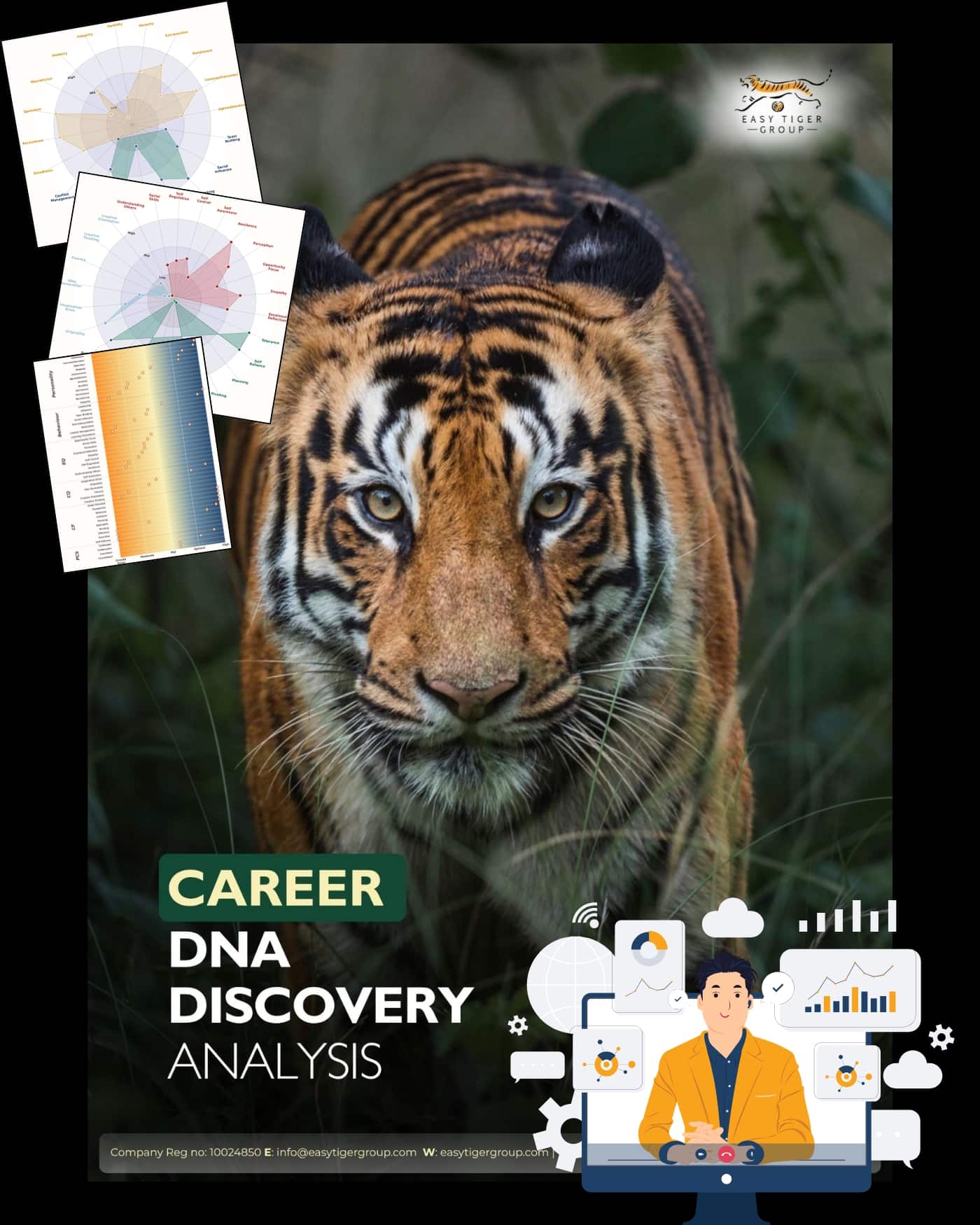
49 documented metrics across six categories.
Each category looks at a different part of how someone may approach
work, people, decisions, challenges and development.
View
06 Professional Conversational Style
What it explores
How someone may challenge, collaborate, build agreement, create clarity and adapt their communication.
Research informing the framework
Workplace communication, listening, trust and team-interaction research including Kluger & Itzchakov (2022).
View
05 Cognitive Flexibility
What it explores
Adaptation, strategy shifting, planning, accuracy and behavioural adjustment during structured tasks.
Research informing the framework
Hohl & Dolcos (2024), alongside research into game-based and behavioural cognitive assessment.
View
04 Creative Quotient
What it explores
Idea generation, originality, imaginative thinking and the application of ideas.
Research informing the framework
Amabile & Pratt (2016), alongside research into divergent and creative thinking.
View
03 Emotional Quotient
What it explores
Emotional awareness, self-regulation, interpersonal understanding, resilience and perspective-taking.
Research informing the framework
Mayer, Caruso & Salovey (2016), alongside workplace emotional-competence research.
View
02 Behavioural Traits
What it explores
How tendencies may appear through action, collaboration, leadership, influence, conflict and growth.
Research informing the framework
Workplace leadership, team effectiveness and learning-behaviour research.
View
01 Personality Traits
What it explores
Recurring patterns in how someone approaches people, tasks, pressure, values, decisions and follow-through.
Research informing the framework
Big Five research, including Soto & John (2017), and HEXACO research including Lee & Ashton (2018).
A three-dimensional framework
Career DNA Discovery™ Analysis does not work on a one-question, one-trait basis.
The methodology brings together three dimensions of evidence so that responses can be understood as part of a wider professional-development pattern.
01. Research-defined metrics
Each of the 49 metrics has a defined professional-development meaning. The research establishes the construct being explored. Career DNA then applies that construct within a workplace and career-development context.
02. Multiple categories
A response does not always relate neatly to one isolated characteristic. Where the construct logic supports it, a response can contribute evidence to more than one relevant metric across the six development categories. This allows the analysis to recognise relationships between areas such as behaviour, emotion, communication, creativity and professional decision-making rather than treating them as disconnected boxes.
03. Multiple response formats
The same underlying metric can also be explored through different types of evidence. Career DNA uses Yes / No questions, multiple choice, Likert responses, timed scenarios, sorting tasks and interactive puzzles. Evidence gathered through one format can therefore be considered alongside relevant evidence appearing elsewhere in the analysis.
The aim is not to let one answer define a person. It is to understand the pattern created across the wider analysis.
Designed for professional development
Career DNA Discovery™ is a research-informed professional-development analysis. Established research informs the constructs and framework. Theory-informed methodology determines how those constructs are explored within Career DNA. Pilot testing provides evidence about the user experience. Practitioner feedback contributes to the practical application of the output. Career DNA Discovery™ does not treat theory-informed weighting as empirical factor loading, formative user feedback as formal psychometric validation, or career pathways as predictions of future performance.
Not designed as
· A clinical or diagnostic assessment · An IQ test · A fixed personality type · A performance judgement · A prediction of career success · A standalone selection tool
No single response is treated as a judgement of the individual. Reports consider the wider pattern and context and include human oversight and internal quality-assurance review.
Selected research informing the methodology
Career DNA Discovery™ draws on established psychological, behavioural and workplace research. The references below represent selected research informing the constructs, analysis framework and measurement approach rather than an exhaustive bibliography.
Constructs and personality
- Soto, C. J. & John, O. P. (2017). The Next Big Five Inventory (BFI-2). Journal of Personality and Social Psychology.
- Lee, K. & Ashton, M. C. (2018). Psychometric Properties of the HEXACO-100. Assessment.
- Messick, S. (1995). Validity of Psychological Assessment. American Psychologist.
Emotional and interpersonal development
- Mayer, J. D., Caruso, D. R. & Salovey, P. (2016). The Ability Model of Emotional Intelligence: Principles and Updates. Emotion Review.
- Kluger, A. N. & Itzchakov, G. (2022). The Power of Listening at Work. Annual Review of Organizational Psychology and Organizational Behavior.
Creativity and cognitive flexibility
- Amabile, T. M. & Pratt, M. G. (2016). The Dynamic Componential Model of Creativity and Innovation in Organizations. Research in Organizational Behavior.
- Hohl, K. & Dolcos, S. (2024). Measuring Cognitive Flexibility. Frontiers in Human Neuroscience.
Response and measurement design
- Kam, C. C. S. & Meyer, J. P. (2015). How Careless Responding and Acquiescence Response Bias Can Influence Construct Dimensionality. Organizational Research Methods.
- Brown, A. & Maydeu-Olivares, A. (2011). Item Response Modeling of Forced-Choice Questionnaires. Educational and Psychological Measurement.